What is a heat pump?
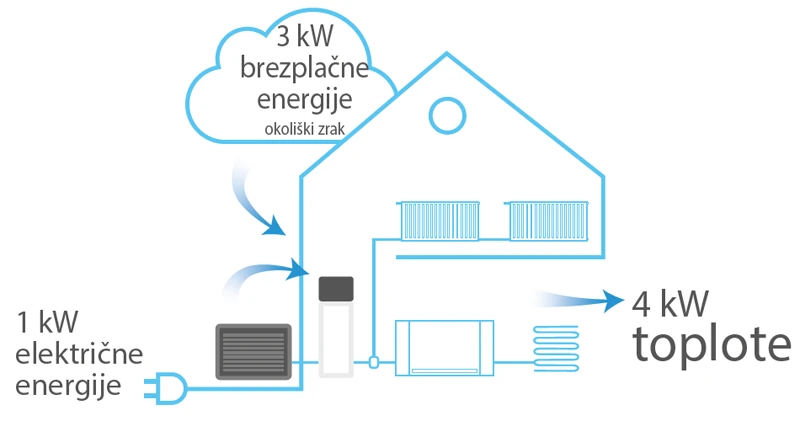
A heat pump is a heating device that harnesses heat from the environment (ambient air, soil or groundwater) and transfers it to the heating system of the house through a compression refrigeration circuit. It works in a similar way to a refrigerator, but in reverse: instead of transferring heat away, it transfers it into the house. The key advantage of heat pumps is efficiency - they can provide 3-5 kWh of usable heat from 1 kWh of electricity, which means significantly lower heating costs compared to fuel oil, gas or direct electric heating.
How does a heat pump work?
The operation of a heat pump is based on a closed refrigeration circuit and the physical fact that a fluid receives heat from its surroundings when it evaporates and gives off heat to its surroundings when it condenses. Based on this closed circuit, the operation of a heat pump can be divided into four key phases:
- Evaporator (heat exchanger on the primary side)
The refrigerant (a working fluid with a fairly low boiling point) is circulated in the evaporator. The fan blows in outside air (in the case of an air/water system) or the heat is removed from the earth or water (in the case of earth/water, water/water systems). In doing so, the refrigerant absorbs heat from the surroundings and changes from a liquid to a gaseous state - it evaporates. Important: we do not »create« heat, we change its form. - Compressor
The gaseous refrigerant then flows into the compressor. The compressor compresses the gas, which heats it to a higher temperature and pressure. This is the only part of the process where the machine actively consumes electricity. The electricity consumed by the compressor is the 1 kWh of input that gives us several kWh of heat output. - Condenser (heat exchanger on the heating side)
The hot gas from the compressor enters the condenser. There, it sends its heat to the building's heating system: water for radiant heating, underfloor heating or a domestic hot water cylinder. Once the refrigerant has given up its heat, it cools and condenses back to a liquid state. - Expansion valve (throttle element)
After the heat is released, the refrigerant passes through an expansion valve where the pressure drops. The liquid is further cooled and is ready for another cycle in the evaporator.

This circuit runs continuously as long as there is a need for heating. The system is very efficient for low-temperature heating such as underfloor heating, because a lower rising temperature is needed for comfort (e.g. 30-40 °C instead of 60-70 °C for conventional radiators). A lower required water temperature means a higher efficiency of the heat pump.
Why is this important for costs?
Since most of the heat is actually taken from the environment, we only pay for the electricity that drives the compressor. That's why heat pumps are now the solution of choice for new buildings and, increasingly, for renovating heating systems.
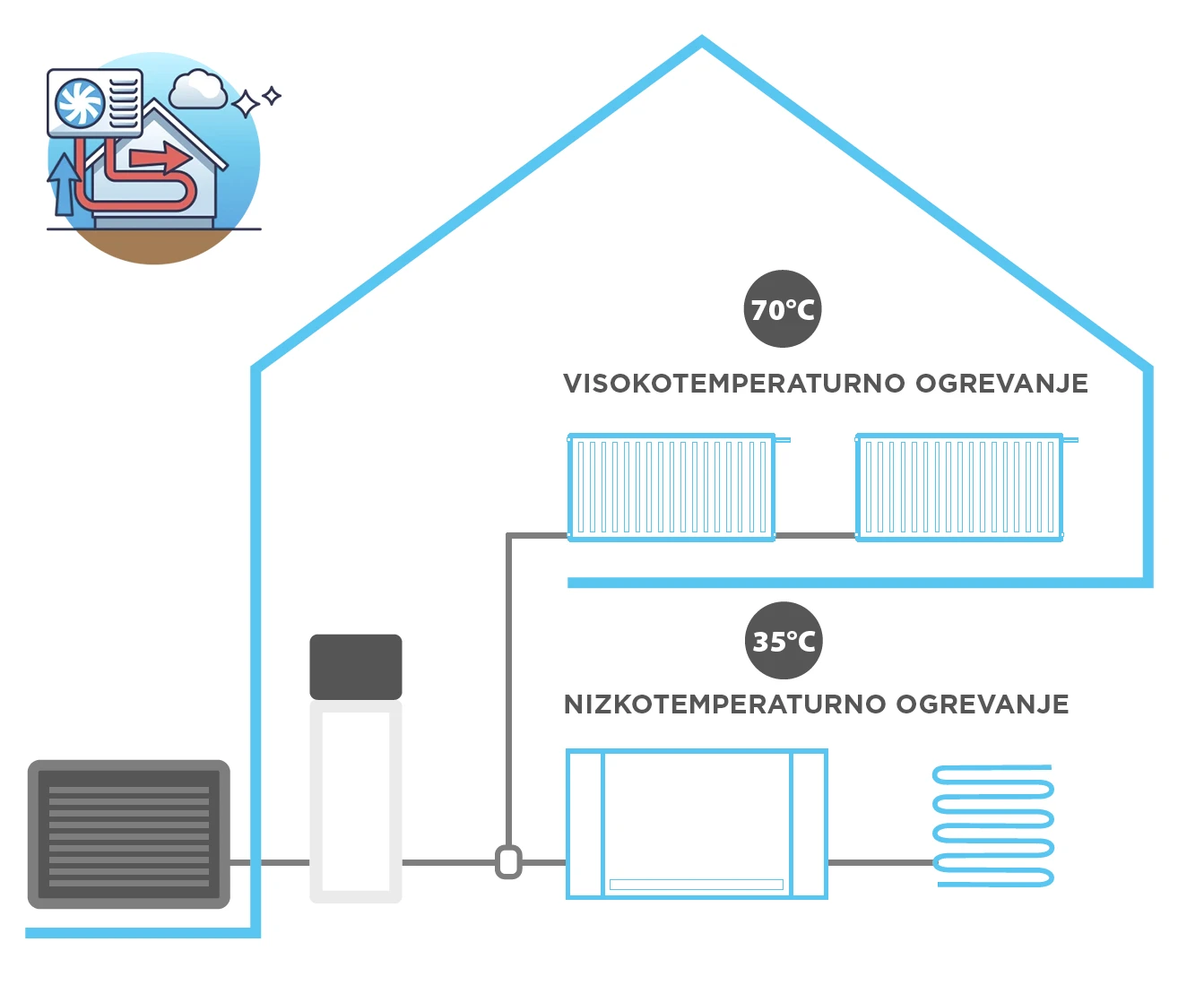
How does an air-to-water heat pump work?
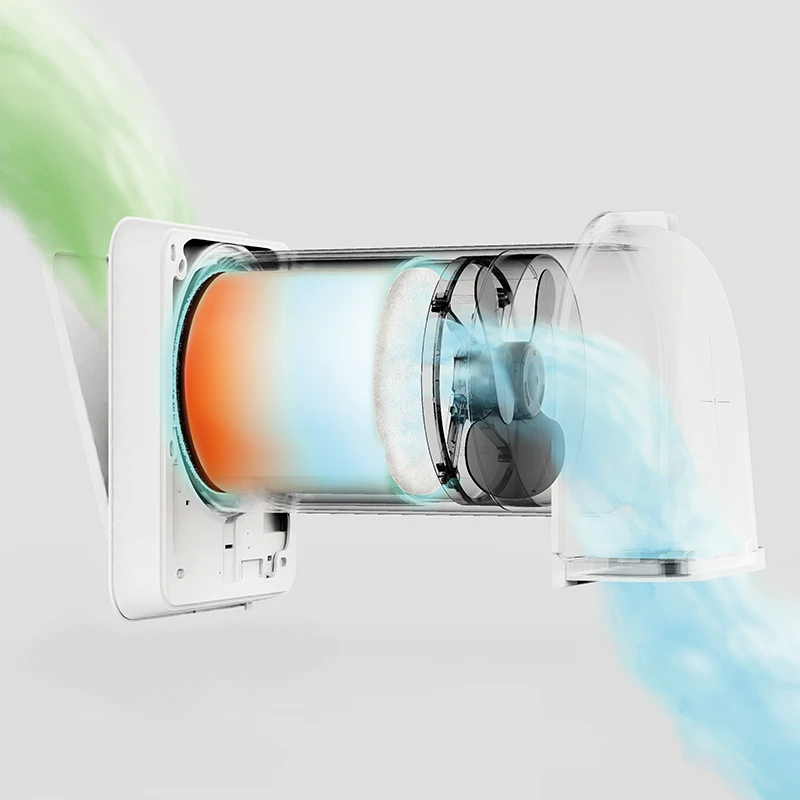
An air-to-water heat pump takes heat from the outside air and transfers it to the water heating circuit of the house (radiators, underfloor heating, storage tank). A fan draws the outside air through the evaporator coil, where the refrigerant absorbs the heat even at low outside temperatures. This means that the system works even in winter when the outside temperature is 0 °C or below - with slightly lower efficiency, of course, because there is less heat available in the air. The main advantage of the air-to-water version is the simpler installation, without boreholes or ground collectors.
How does a heat pump for domestic hot water work?
Heat pump for sanitary water is a dedicated system for producing hot water for consumption (shower, kitchen), usually with its own boiler. The principle of operation is the same as for a large heat pump, except that it transfers heat from the ambient air (e.g. from a cellar, a utility room or even from the exhaust hot air of ventilation) directly to the sanitary water in the tank. This is significantly more economical than a conventional electric boiler with a resistance heater, as it uses a compression refrigeration circuit instead of direct resistance heating.
How many kWh does a heat pump use?
Heat pump consumption is always the result of two key factors:
- the thermal needs of the building (insulation, house size, ventilation, desired indoor temperature),
- the efficiency of the appliance (the so-called heating value or COP).
A concrete practical example
A well-insulated single-family house of about 120-150 m² with underfloor heating and a typical living temperature of about 21 °C can require about 3,000-5,000 kWh of heat per season.
If an installed heat pump has a seasonal COP of around 3, this means that it uses about a third of the electricity to produce those 3,000-5,000 kWh of heat - so roughly 1,000-1,700 kWh of electricity over the whole heating period.
To give you an idea: 1,500 kWh of electricity per season means an average of about 250 kWh per month during the heating months.
When will consumption be higher and when lower?
Consumption will be higher when:
- the house is poorly insulated,
- higher heating water temperatures are required (e.g. old radiators with 55-60 °C risers),
- the building has a very open architecture,
- outside temperatures are often very low.
However, consumption can be significantly lower in passive houses and new builds with:
- low-temperature underfloor heating,
- air recuperation and good thermal insulation.
To the question »How many kWh does a heat pump use?« there is no single answer - it is always determined by the house, not just the appliance. However, for the same property, a heat pump will almost always use less electricity than direct electric radiators or IR panels, as it has a COP (Coefficient of Performance) of more than 1.
How many kWh does a heat pump for domestic hot water use?
If we are only talking about domestic hot water for an average household of 3-4 people, a domestic hot water heat pump typically uses a few hundred kWh of electricity per year, not thousands. Why? Because, again, it usefully transfers heat from the air to the boiler instead of heating the water directly with a resistance heater. This means that the cost of hot water drops significantly compared to a conventional electric boiler.
How much does a heat pump cost?
We look at price in two parts:
- the device itself + hydraulics, installation and commissioning,
- possible adjustments to the system (storage tank, sanitary water tank, hydraulic connections, replacement of radiators in older houses).
For a single-family house, typical air-to-water heat pumps for space heating and domestic hot water are usually in the range of a few thousand euros per unit, plus installation and adaptation of the existing system. In retrofit projects, the biggest cost is often not the pump itself, but the hydraulic adaptation (e.g. if there was previously oil and a high-temperature regime).
It makes sense to look at the total investment in the heating system, not just the price of the appliance per unit. The reason: the most »cheap« appliance is not necessarily the cheapest in the long term if it has a lower efficiency or if in practice it will switch repeatedly to an electric heater at low temperatures.
Which heat pump is best?
There is no one-size-fits-all answer to the question »which heat pump is best«, because »best« means something different in every house. When making your choice, pay particular attention to the points listed below.
- Heat source (air-to-water, ground-to-water, water-to-water)
- Air-to-water: the most common choice due to ease of installation and lower initial investment.
- Ground-to-water (probe or ground collector): very stable efficiency even in the coldest part of winter, but requires drilling probes or a large land area.
- Water-to-water: a very efficient system if you have a stable water source of adequate quality, but administratively and technically more complex.
- House heating temperature regime
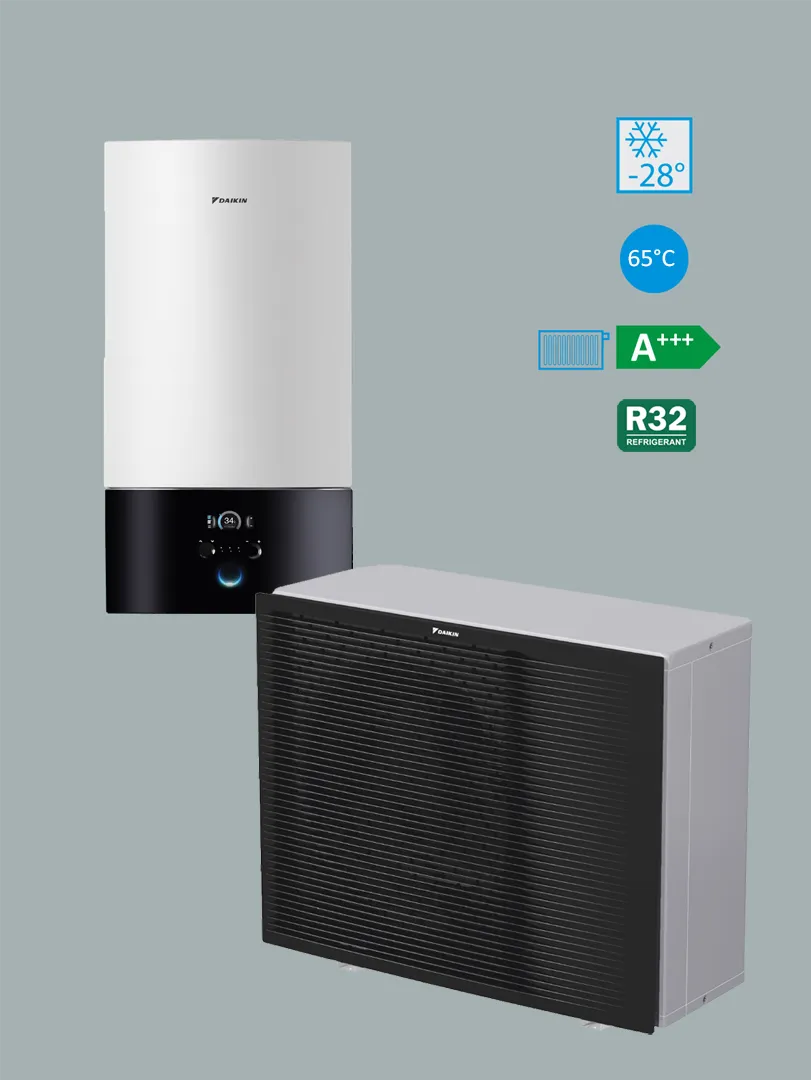
If you have underfloor heating and low-temperature radiators (e.g. a converted radiator system with larger surfaces), you can choose a standard low-temperature pump. If you have old cast-iron radiators that require 60 °C or more for comfort, you need a high-temperature heat pump. This is usually more expensive and slightly less efficient, but allows you to install it without a complete overhaul of the heating system. - Noise and location of the outdoor unit (heat exchanger on the heating side)
For air-to-water versions, the operating culture (low noise, vibration damping, night mode) is very important in denser housing and terraced houses. - Management and regulation
A good heat pump is more than just a compressor. The key is how the system controls the riser temperature according to the outside temperature, schedules, occupancy, domestic hot water production and any other sources (fireplace, solar power). Smart control has a direct impact on kWh consumption and comfort. - Service support and parts availability
Even the best device on paper is not a good choice if in practice there is no local service, no spare parts supply and no expert support to start up and optimise settings.

So: the »best« heat pump is the one that is correctly sized for your house, has a stable support and works efficiently in the long term under your actual conditions (enclosed atrium in the city ≠ detached house in the countryside; underfloor heating ≠ old radiators).
What is a heat pump - summary
- A heat pump is a system that takes heat from the surroundings and, with the help of a compressor, raises it to a usable temperature for space or domestic hot water heating.
- It works on a refrigeration cycle (evaporator → compressor → condenser → expansion), similar to a refrigerator, but it pumps heat into the house instead of out of it.
- Consumption in kWh is not a fixed figure, but depends on the house and the heating regime. In a well-insulated house, we can talk about 1,000-1,700 kWh of electricity per season for space heating.
- Air-to-water is the most widely used version due to its investment-to-savings ratio and relative ease of installation.
- A sanitary heat pump is a dedicated source of hot water that significantly reduces the cost of heating the boiler.
- The price of the system is not just the device. It is also crucial whether the heating circuit of the house is adapted to low-temperature operation.
- The best heat pump is the one that is correctly sized, works in your temperature regime, is quiet and has the service support to actually deliver the promised savings over the years.


Ask us
For any further questions or advice on the correct selection and installation of heating systems, please contact us and we will be happy to help!