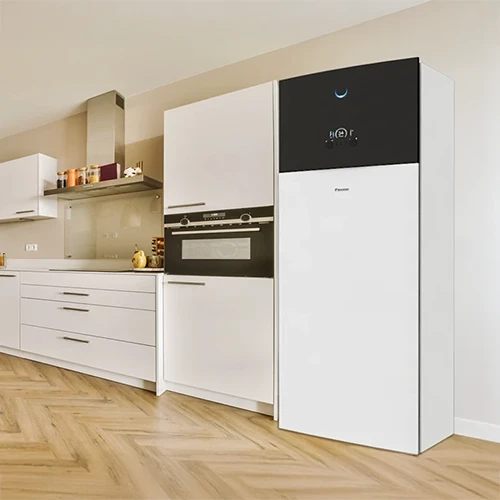
Heat pump for an apartment: when is it possible, which one to choose and how much does it cost?
A residential heat pump can be an effective replacement for a gas central heating boiler, electric heating, or a traditional method of producing hot water. Whether it is feasible and sensible in your case depends on several factors: how the apartment is heated today, whether you have radiators or underfloor heating, where the outdoor unit could be installed, and what consents are required in a multi-unit building.
This guide collects answers to the questions that apartment owners most often ask before making a decision: which types of heat pumps are available, how to determine the power, whether the heat pump works with existing radiators, what applies to noise and consent, and how much of an eco fund subsidy you can expect.
In short: The heat pump for heating is easiest to install in an apartment that has own (individual) heating system, For example, a gas-fired boiler. In homes with remote heating, disconnection is only possible under legally stipulated conditions, so that is often the most feasible solution there. sanitary heat pump for the preparation of hot water. For apartments with radiators, heat pumps with a higher temperature of the feed water (up to 65 or 70 °C) are suitable.
Contents of the article
- Can I install a heat pump in my apartment?
- What types of heat pumps are suitable for apartments?
- Heat pump and radiators: should they be replaced?
- How to determine the power of a heat pump for an apartment?
- Where to install the outdoor and indoor unit?
- Noise: what will the neighbors say?
- Consens in a multi-apartment building
- How much does a heat pump cost for an apartment?
- Subsidized by the Eco Fund for a heat pump in an apartment
- Steps to a heat pump in an apartment
- When is a heat pump not the best choice?
- Frequently asked questions
Can I install a heat pump in my apartment?
Yes, but in most cases the feasibility depends on, How is the apartment heated today. In multi-apartment buildings, we encounter three basic cases.
Current heating mode | Is the transition to a heat pump possible? | What to check |
Individual system (gas-fired floor-standing stove, electric boiler, oil boiler) | As a rule, yes, this is the most common and simplest case. | Space for an external unit, consent for interference with common parts, and in the case of gas, consent from the distributor to shut off the gas supply. |
Common boiler room for the entire building | It is possible to transition the entire building; the individual exit of each apartment is demanding. | Decision by the floor owners with the appropriate majority, maintenance plan, manager. |
Remote heating | Only under legally determined conditions and with the consent of the heat distributor. | The efficiency of the district heating system, the conditions of the distributor, the consent of the owners. |
Even when replacing the heating system is not possible, you can almost always reduce the cost of preparing hot water in the apartment. Sanitary heat pump It replaces the classic electric boiler and does not interfere with the building's overall heating system.
What types of heat pumps are suitable for apartments?
Heat pumps are primarily suitable for apartments, which extract heat from the outside air. Geothermal installations (ground/water, water/water) require wells or ground collectors, so they are rare in blocks of flats.
Air/water heat pump in split version
It is composed of external unit, which removes heat from the air, and internal unit, The unit connects pipes with a heater. This version connects to existing radiators or underfloor heating and is the most common replacement for a gas-fired boiler. The wall-mounted indoor units are compact: Wall-mounted installation of the Daikin Altherma 3 H MT heat pump It needs approximately 440 x 840 mm of wall space, which is comparable to a floor-standing gas stove.
Air/water heat pump in a monoblock design
In the monoblock version, the entire cooling circuit is located in the outdoor unit, and pipes carrying heating water run to the apartment. Installation is simpler because no need to work with a chiller; the outdoor unit is usually larger. When choosing, it is necessary to consider the protection against freezing of the pipes that run outside.
Air-to-air heat pump
In practice, it is a climate device that heats and cools the air in a particular room. It is suitable as supplementary heating or in smaller, well-insulated apartments. It does not heat radiators and does not produce hot water; the heat is distributed less evenly throughout the apartment than with radiator or underfloor heating.
Sanitary heat pump
It is intended solely for the preparation of hot sanitary water. In an apartment, it is often the quickest measure to take, as it does not require an external unit and does not interfere with the building’s heating system. The air can be captured from the space in which it is located, or the air is supplied and drained through channels. If you are interested in a more detailed comparison of the size of the storage tanks, read our guide on the 300-liter thermal water heat pump.
Type | Heating of premises | Warm water | Cooling | External unit | Typical use in an apartment |
Air/water split | Yes (radiators, floor) | Yes, with a water heater | depending on the model | yes, smaller | replacement of a gas floor-standing stove |
Air/water monoblock | Yes (radiators, floor) | Yes, with a water heater | depending on the model | Yes, larger | apartments with enough space on the balcony or terrace |
Air/air | Yes, by individual spaces | No | Yes | Yes | Supplementary heating and cooling |
Sanitary | No | Yes | no (it can cool the space it is standing in) | No | replacement of an electric boiler |

Heat pump and radiators: should they be replaced?
Older homes mostly have radiator heating, which was designed for high temperatures of the heating water. This is one of the main reasons for concerns about heat pumps. Low-temperature heat pumps are, after all, most efficient at water-supply temperatures around 35 °C, which is sufficient for floor heating, but not often enough for radiators on cold days. Therefore, choose apartments with radiators. medium- or high-temperature heat pump:- Daikin Altherma 3 H MT achieves the temperature of the heating water up to 65 °C and operates at outdoor temperatures down to −28 °C.
- Daikin Altherma 3 H HT achieves the temperature of the heating water up to 70 °C, Therefore, it is suitable for renovations where you do not want to replace the radiators. It operates without an electric heater at the rated power up to an external temperature of −15 °C.
How to determine the power of a heat pump for an apartment?
The power of the heat pump is determined according to heat loss of the dwelling, Not only in terms of its square footage. Losses are affected by the location of the apartment within the building (on the corner, under the roof, above an unheated basement, or somewhere in between), the insulation of the facade, the windows, and the desired indoor temperature.
For the first, approximate assessment, the empirical values of specific heat capacity are used:
The state of the apartment | Frame required power per m² | Example for 60 m² |
Older building without insulation of the facade, old windows | 100 to 150 W/m² | 6 to 9 kW |
Partly or completely renovated building | 50 to 80 W/m² | 3 to 5 kW |
New construction, low-energy building | 30 to 50 W/m² | 2 to 3 kW |
Intermediate apartments generally have lower losses due to neighboring heated apartments than corner apartments or apartments under the roof. A more reliable method is the calculation from Current energy consumptionFrom the annual consumption of gas or electricity for heating, the actual thermal needs of the dwelling can be estimated quite accurately.
A oversized heat pump often switches the compressor on and off, which reduces efficiency and shortens lifespan. However, in the coldest days, it works more with an electric heater. Instead, the final power should be determined by a professional based on a calculation.

Where to install the outdoor and indoor unit?
External unit It is most often installed in apartments on balconies, loggias, terraces, or facades. When choosing a location, consider the following:
- sufficient space for air flow in front of and behind the unit,
- the drainage of condensate generated during heating and defrosting,
- load bearing capacity of the base and the use of anti-vibration mounts,
- the distance from the windows of the bedrooms, both yours and your neighbors’,
- the length of the connection to the internal unit,
- access for servicing.
Installing a balcony in blocks is often the simplest solution because it does not interfere with the facade. However, check the house rules and any consents (more about this below).
Internal unit In wall-mounted versions, it takes up approximately the same amount of space as an under-floor gas stove, so you can often install it in the place of an existing stove where the heating pipes are already in place. To generate hot water, you also need a sanitary water heater, which must be installed in the bathroom, storage room, or laundry room.
Noise: what will the neighbors say?
Noise is one of the most common questions in blocks, and it is justified. Modern outdoor units are significantly quieter than older air conditioners. For an outdoor unit Daikin Altherma 3 H HT the manufacturer indicates the sound pressure 35 or 38 dB, measured at a distance of 3 meters.
When comparing devices, be careful to check whether it is listed. acoustic pressure (dependent on the measurement distance) or acoustic power (device property). The numbers are not directly comparable.
Mounting also affects actual sound performance. Install the unit on anti-vibration mounts, not in a narrow gap between two walls where sound is reflected, and as far away from adjacent windows as possible. Many devices also have a night or silent mode that limits the fan and compressor speed at night.
Consens in a multi-apartment building
The legal aspect is often more complex than the technical one when it comes to apartments. Below are the main questions that need to be clarified before buying.
Interference with common parts of the building
The facade, roof, and common areas are shared by all floor owners. Installing an external unit on the facade or penetrating the external wall therefore requires the consent of the floor owners; the required majority depends on the type of intervention. Installing on a private balcony is usually less demanding, but the house rules or the mutual relations agreement may dictate otherwise. Before the intervention, consult the building manager.
Disconnecting from the remote heating system
Disconnection of an individual demand point from district heating is possible only if the conditions stipulated by legislation (including regarding the efficiency of the district heating system) are met, and disconnection must be obtained. agreement of the heat distributor. In practice, this means that an individual owner in a block with remote heating cannot, for the most part, independently switch to a space heating heat pump. Please check the conditions with your distributor.
Disconnect from the gas pipeline network
Consent from the distributor is also required for disconnection from the natural gas distribution system. This is also important for the subsidy, as the Eko Fund requires the investor to ensure that the investment complies with applicable regulations.
How much does a heat pump cost for an apartment?
When searching for the information »heat pump for apartment price«, the price of the device and the installation costs must be separated. the entire investment. The final amount depends on:
- types of heat pump (sanitary, air/water split or monoblock, air/air),
- the required power and temperature of the lifting water (low-, medium- or high-temperature version),
- a sanitary water heater, if you need it,
- length of installations and complexity of assembly,
- any adjustments to the heating system (filter, expansion tank, hydraulic balancing, replacement of radiators),
- the costs of dismantling and disconnecting the old system.
The lowest investment is a sanitary heat pump. For your reference: SELTRON SAN 300 with exchanger currently costs 2,199 € + VAT, Without installation. The air-to-water heat pump for space heating is a larger investment due to the external unit, the internal unit, the water heater, and more demanding installation. Since prices are changing, the most reliable offer is prepared for your apartment.
How to assess whether the investment is profitable?
Compare Annual costs of heating and preparing hot water With the current system and the new one. The savings are greatest when switching from direct electric heating to liquefied petroleum gas, and smaller when switching from natural gas. Also consider the subsidy, the costs of maintaining an old device (chimney inspections, servicing of the gas stove, gas network charges), which are eliminated, and the option of cooling in summer if the selected device allows for it.
Subsidized by the Eco Fund for a heat pump in an apartment
The eco fund published on April 16, 2026 Public call 126SUB-OB26, which applies to investments made from March 1, 2026 onwards. The incentive is also eligible for owners of apartments in multi-apartment buildings.
Air/water heat pump | Amount of incentive |
Replacement of the old fossil fuel (gas, fuel oil, solid fuels) heating device | up to 50 % recognized costs, maximum 4,500 € |
First installation or installation without replacing the old combustion device | up to 20 % recognized costs, maximum 1,000 € |
Additional conditions apply for a higher incentive: the old device must have been in use and heated the central system; after replacement, it must be destroyed; and a photo of the old device and the empty space after removal must be attached to the application. Higher incentives cannot be obtained for replacing a district heating heat station, existing heat pumps, local combustion devices, or electric heating devices. The new heat pump must meet the technical requirements of the call.
The application is submitted after the investment has been completed through the eUprava portal. The terms of public calls are changing, so before purchasing, check the current text of the call on the Eko sklad website.
Steps to a heat pump in an apartment
- Check the current system. Do you have individual heating, a communal boiler room or district heating? This depends on whether the transition is even possible.
- Collect data on consumption. Gas or electricity bills for the last two to three years, the square footage, the location of the apartment, and the type of heating.
- Order a power calculation and a viewing. The expert estimates the heat loss, the required temperature of the heating water, and the possible locations for the outdoor and indoor unit.
- Obtain consent. Consult with the administrator; if necessary, obtain the consent of the floor owners and the consent of the distributor to disconnect from the gas supply.
- Check the conditions of the subsidy. Choose a device that meets the requirements of the public call and save the documentation of the old device.
- Assembly and commissioning. Installation in an apartment where the heating system has already been installed usually takes a few days.
- Submit the application for the subsidy after the completed and paid investment.
When is a heat pump not the best choice?
A heat pump is not suitable for every apartment. Before making a decision, consider the following cases:
- The apartment is connected to a remote heating system. and the conditions for disconnection are not met. In this case, a sanitary heat pump makes sense instead of an electric boiler.
- There is no suitable place for an external unit, However, consent from the floor owners cannot be obtained.
- The apartment has very high heat loss, The radiators are too small. Without at least partial renovation, the device will operate at low efficiency in the cold. In this case, it makes sense to first reduce losses or choose a high-temperature version.
- The apartment has very low consumption (small, well-insulated). The investment in the air/water system can take a very long time; a heat pump air/air system may suffice.
SELTRON solutions for apartments
The SELTRON range includes devices for both main cases in homes: space heating and the preparation of hot water.
- Daikin Altherma 3 H MT: Air-to-water heat pump with heating water temperature up to 65 °C, operation up to −28 °C and energy efficiency class up to A+++. Also available in a compact wall-mounted version.
- Daikin Altherma 3 H HT: High-temperature heat pump with heating water temperature up to 70 °C, intended for renovations with existing radiators. Sound pressure of the external unit 35 or 38 dB at a distance of 3 m.
- SELTRON SAN: Sanitary heat pump with patented capillary exchanger, stratification system that provides up to 20 % more available hot water, additional heat exchangers and PV function for using electricity from a solar power plant. It allows remote air capture and extraction, which is often crucial in apartments.
Do you need help choosing a heat pump for your apartment?
The correct choice depends on the current heating system, heat losses, the type of heating, and the available space. Take a look at the SELTRON heat pump range or send us an inquiry with your apartment details and current consumption. Based on this, we will suggest the appropriate solution and the power of the device.